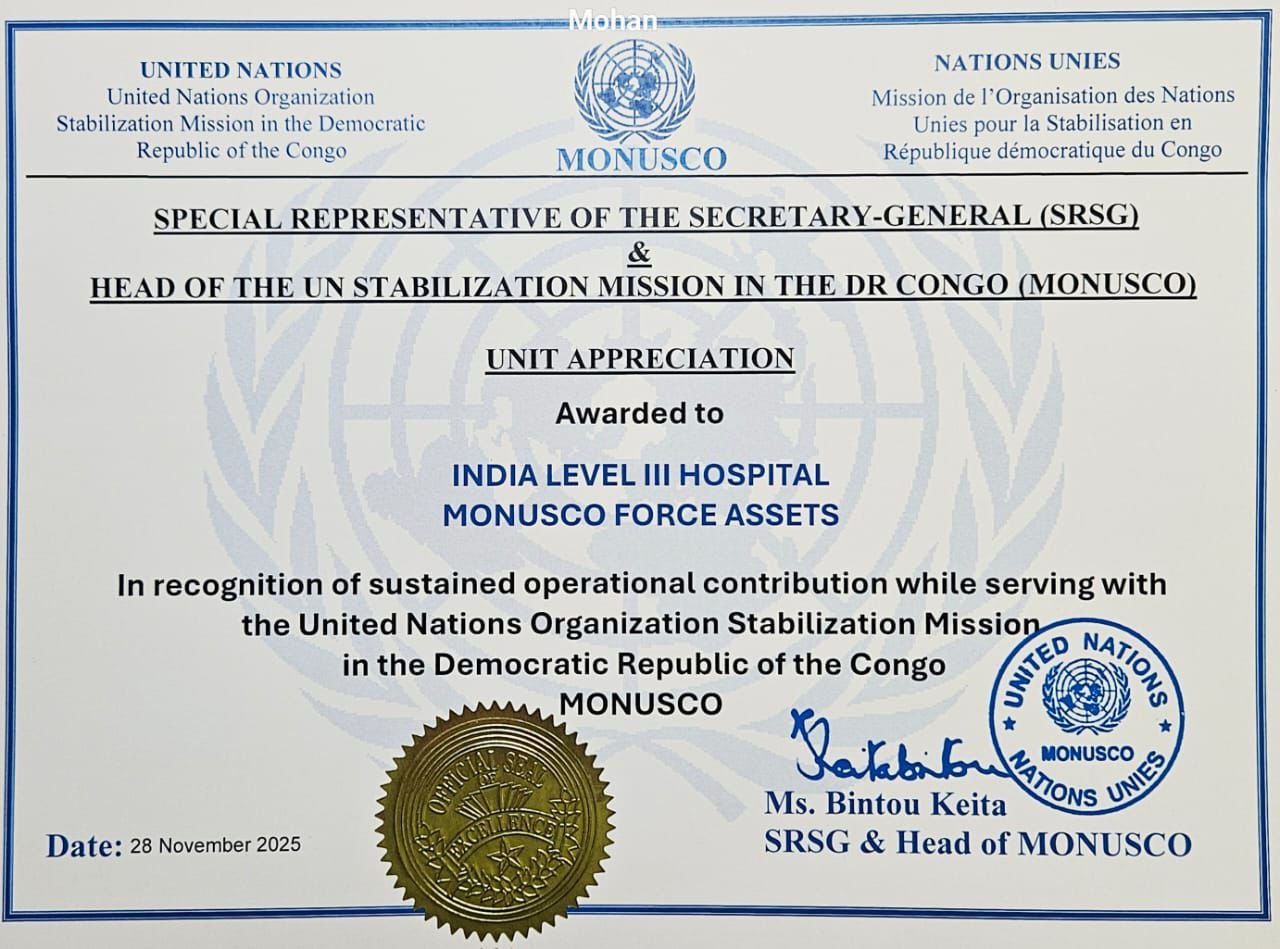
The recent news about India’s Level II Plus Hospital located at Goma, Democratic Republic of Congo (DRC), being conferred the SRSG and Head of MONUSCO Unit Appreciation Citation reignited memories of my own tenure as a Military Observer in the DRC during 2004–05. I was then deployed as the Coordinator of the Joint Operations Center, Goma, overseeing operations across North and South Kivu—arguably one of the most volatile theatres of UN peacekeeping at the time.
It was during this period that the United Nations took a major operational decision: to induct an Infantry Brigade each from India and Pakistan, headquartered at Goma and Bukavu respectively. Along with the Indian Brigade came another critical component—the induction of a Level III Military Hospital from India, planned to be located at Goma. At the time, this was not just a medical deployment; it was a strategic enabler for peacekeeping in eastern Congo.
Soon after the decision, reconnaissance parties arrived in the DRC to identify suitable sites for the Brigade Headquarters, battalion locations, company deployments, and the hospital. I distinctly remember the palpable excitement among the locals in Goma when word spread that an Indian hospital was to be established in the city. This enthusiasm was not accidental. It stemmed from a deeply held belief in the professionalism, compassion, and competence associated with India and Indians. Long before the first aircraft landed, India’s reputation had already paved the way.
As per India’s contract with the UN, the hospital had to be fully self-contained. Consequently, UN administrative authorities began scouting for open ground where the hospital could be set up in tentage. On paper, this seemed routine. On the ground, it was anything but. Goma sits in the shadow of Nyiragongo, one of the most active volcanoes in Africa.
The city itself has been devastated multiple times by eruptions, leaving much of it standing on volcanic rock. From a medical standpoint, this raised serious concerns—especially regarding infection control during and after surgical procedures.
Several locations were examined by the reconnaissance team, and the issue was debated intensely within both civilian and military components of the mission. Days turned into weeks. Eventually, the focus shifted to a three-storey hotel located in the heart of Goma. The irony was hard to miss. The hotel housed nearly 15 UN officials, some of whom were directly involved in the decision-making process. Accepting the hotel as the hospital site meant dislodging themselves. Resistance was natural.
I still recall receiving repeated emails from senior Medical Corps officers from India, anxious about the finalisation of the site. Time was of the essence. Finally, pragmatism prevailed. The hotel was accepted. The Indian hospital—with its full complement of manpower and equipment—was flown in from India, and within a remarkably short span, it was operational.
At the time of deployment, North and South Kivu were in the grip of active hostilities. The hospital functioned as a Level III facility, mandated not only to treat UN personnel but also civilians. What unfolded thereafter left a lasting impression on me. Doctors, nurses, technicians, and support staff worked far beyond prescribed hours. Mandates blurred in the face of human suffering. Almost everyone who entered the hospital left with a smile—and often with renewed hope. Turning away a patient for lack of authorisation was simply not in the Indian DNA.
My own responsibilities included verification missions, disarmament of militias, and rehabilitation efforts, in coordination with other UN arms and NGOs. This gave me a ringside view of how the hospital’s role organically expanded. Medical camps were organised in inaccessible areas. Casualties from militia clashes were airlifted for treatment. The hospital became not just a medical facility, but a humanitarian anchor in a fractured land.
Two decades later, the recognition conferred on India’s Level II Plus Hospital in Goma feels deeply personal. It is a reminder that what began as a logistical and operational decision in 2004 evolved into an enduring symbol of India’s peacekeeping ethos. The citation acknowledges not just clinical excellence, but resilience under fire, compassion under constraint, and service beyond mandate.
In conflict zones, weapons may enforce ceasefires, but it is institutions like these hospitals that win trust. India’s medical presence in Goma has done precisely that—quietly, consistently, and with humanity. The recent award merely formalises what the people of Goma have known for years: when India heals, it heals without conditions.DD
Geostrategic Analyst