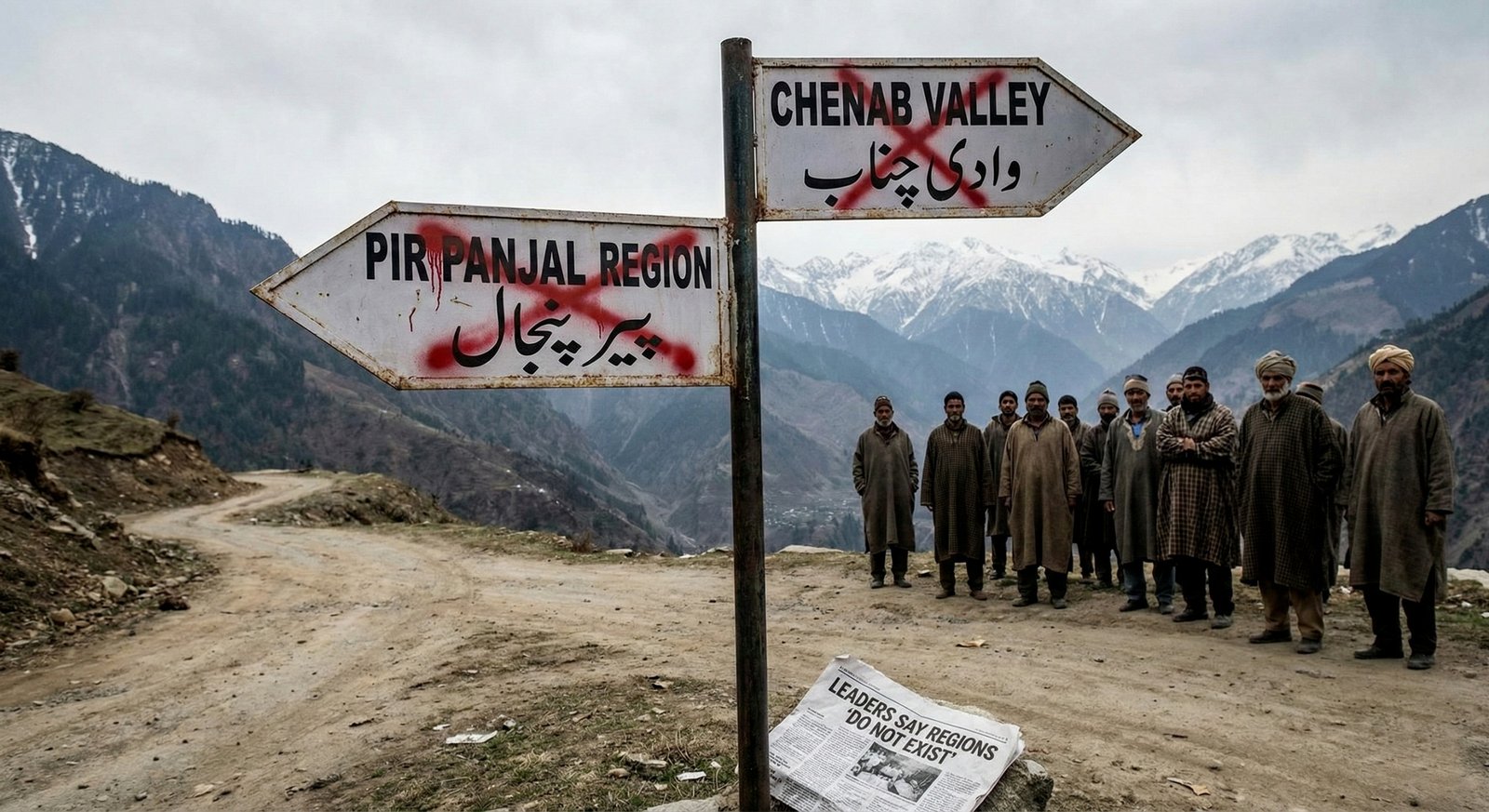

If geography is destiny, then the mountains of Jammu and Kashmir have already written a script that no political statement can erase. The recent assertion by Jammu’s opposition leadership that the “Pir Panjal” and “Chenab Valley” regions do not exist—labeling them merely as parts of a “Chandrabhaga” or unitary Jammu division—forces us to confront a fundamental question: What makes a region real? Is it a line on a revenue map, or is it the shared memory, language, and struggle of the people who inhabit it?
While the political narrative in the Jammu plains seeks to consolidate a monolithic “Dogra” identity to counter the Kashmir Valley, the view from the mountains is starkly different. For the residents of Rajouri, Poonch, Doda, Kishtwar, and Ramban, the names “Pir Panjal” and “Chenab Valley” are not separatist fictions. They are lived realities, rooted in administrative necessity, distinct cultural heritage, and a history of systemic neglect that has made “Jammu” feel less like a motherland and more like a distant administrative landlord.
The Administrative Truth: The State’s Own Language
The most glaring contradiction in the “non-existence” argument comes from the Indian state itself. The government’s own machinery has long institutionalized these identities, not out of conspiracy, but out of geographic necessity.
Consider the Chenab Valley Power Projects Limited (CVPPL). This joint venture between the Central Government and the J&K administration is not named “Jammu Power Projects.” It carries the name of the valley it harnesses. The state admits, through its corporate nomenclature, that this distinct geological and hydrological entity is the powerhouse of the region. To deny the “Chenab Valley” is to deny the very source of the hydroelectric wealth that lights up the homes of the plains.
Similarly, the J&K Police administratively divides the region into the “Rajouri-Poonch Range” and the “Doda-Kishtwar-Ramban Range”. Why? Because policing the rugged, militants-infested forests of the Pir Panjal requires a completely different operational logic than policing the streets of Jammu city. The geography demands a distinct administrative approach. When the state treats them separately for security and development, the people inevitably see themselves as separate.
The Myth of “Chandrabhaga”
The attempt to rename these regions as “Chandrabhaga”—the ancient Sanskrit name for the Chenab river—is a transparent exercise in cultural retrofitting. While “Chandrabhaga” is historically accurate as a hydronym (river name), applying it as a blanket administrative label for the diverse populations of Rajouri (Pir Panjal) and Doda (Chenab) is historically tenuous.
The term Pir Panjal is not a recent invention; it appears in the Rajatarangini (as Panchaladeva) and Mughal chronicles. It denotes the barrier that has defined the region’s history—the mountain wall that shielded Kashmir. To replace this localized, historically rooted name with “Chandrabhaga” is seen by the Pahari and Gujjar communities not as a return to roots, but as an imposition of a “Dogra-centric” cultural hegemony that seeks to flatten their distinct identities.
The “Pahari” and “Chenabi” Soul
The hills speak a different tongue. The “Jammu” identity is anchored in the Dogri language and culture. But cross the Chenab river or climb the Pir Panjal, and the dialect shifts.
In Rajouri and Poonch, the dominant identity is Pahari—a linguistic and cultural group that shares more kinship with the people of Pakistan-administered Kashmir than with the Dogras of Kathua. The recent granting of Scheduled Tribe (ST) status to the Paharis was a recognition of this distinctiveness. You cannot grant a people a separate constitutional status based on their distinct identity on Monday, and then tell them their region “does not exist” on Tuesday.
Similarly, the Chenab Valley is the cradle of a unique syncretic culture—often called “Chenabi“—where Kashmiri, Bhaderwahi, and Gojri blend. It is a zone where the “Kashmiriyat” of the valley meets the pluralism of the hills. By denying this identity, the Jammu leadership risks alienating a population that has refused to be fully subsumed by the separatist sentiment of Kashmir, but also refuses to be erased by the majoritarian politics of Jammu.
The Economics of Neglect
Ultimately, the defense of these identities is rooted in economics. For decades, the hill districts have suffered from what locals call “double discrimination.” They are too far from Srinagar to be Kashmiri, and too Muslim/mountainous to be fully embraced by the Jammu plains.
The numbers tell the story. While Jammu district boasts premier institutions like AIIMS, IIM, and IIT, the Baba Ghulam Shah Badshah University (BGSBU) in Rajouri—the educational lifeline of the Pir Panjal—has seen its funding slashed from over ₹700 lakh to a mere ₹44 lakh in recent years. This “institutional abandonment” fuels the demand for separate status. When a region provides the state with its electricity (Chenab) and its soldiers (Pir Panjal), but receives crumbs in return, asserting a separate identity becomes a survival strategy.