
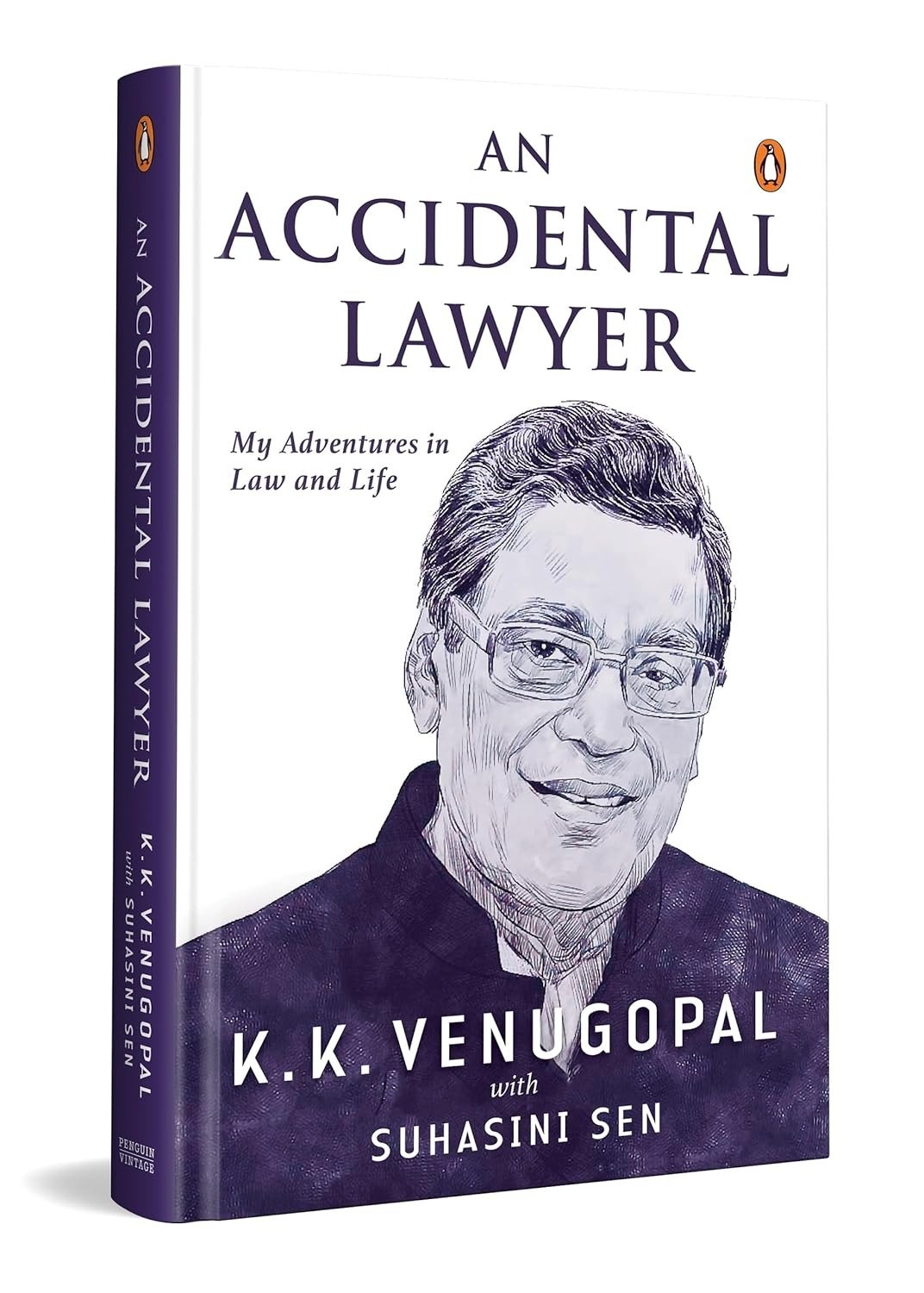
New Delhi, Feb 12 An Accidental Lawyer: My Adventures in Law and Life, the autobiography of senior advocate K.K. Venugipal, as published by Penguin in collaboration with Suhasini Sen, is more than a memoir.
It is an autobiographical, academic, yet not overly complicated story of a lifetime of serving the law, justice, and society. The novel combines courtroom trials and the author’s thoughts, presenting the reader with the lawyer and the man in the robes.
The book demands that the law should be returned to its former stature, not as an instrument of business or persecution, but as a noble profession. The author recalls the boast of Augustus, who discovered Rome built of brick and bequeathed it to be built of marble, and transfigures it into law: to discover it a closed book and leave it an open letter; to change it from the property of the wealthy to the property of the indigent. This is the essence that gives the memoir life.
It is the story of the historical interventions that transformed lives. The writ petition petitioned by Kapila Hingorani in the Hussain ara Khatoon case is one of the cases where thousands of underprivileged inmates who had served longer times in prison than the maximum sentence of their crimes were released.
The case, along with others, is brought forward as evidence that lawyers are indeed social engineers, able to transform society through the courts.
The author emphasizes that the lawyer’s most valuable asset is credibility. Being honest in court, not withholding information that would mislead, and not accepting strikes, which have been ruled illegal by the Supreme Court, are grounds that are not negotiable. Strikes, he says, put justice under ransom and violate the profession.
The book repeatedly emphasizes the importance of public interest litigation and pro bono work. According to it, lawyers must invest their time and effort in individuals who are unable to afford legal assistance. This is not a charity but a debt to society. In its absence, the profession may lose its soul.
The author recalls that lawyers have always led social change, from the Constituent Assembly to the Supreme Court. But he mourns the declining respect for the profession.
Where Cicero referred to a law as a noble profession, Frederick the Great referred to lawyers as leeches. Contemporary criticism, such as Anthony Kronman’s The Lost Lawyer, is also cited to demonstrate how material success has obscured a spiritual crisis in the profession.
The memoir does not exist in the courtrooms. It shows that the author is also a lover of antiquarian books, artefacts, and curiosities. His farm, which he calls a Frozen Zoo, features life-size wooden sculptures of animals and other rare treasures, such as the sword of Aurangzeb, inscribed in Persian.
His work spans centuries and covers Mughal biographies, colonial narratives of tiger hunting, and sati. These interests, he acknowledges, were in conflict with his professional obligations, but they also made his life more interesting and gave him a view outside the law.
The passages in Notes of Gratitude are very personal. The author recognizes the dedication of the employees who worked under him over the decades, and of the juniors who became distinguished lawyers, judges, and ministers. Rohinton Nariman, K.V. Viswanathan, P. Chidambaram, Rangarajan Kumaramangalam, and C.S. Vaidyanathan are among his professional family members. He remembers M.N. Krishnamani, a close associate and devotee of Sai Baba, who was appointed President of the Supreme Court Bar Association.
In his old age, the young associates, like Ankur Talwar, Chinmayee Chandra, Siddhant Kohli, and Suhasini Sen, gave him invaluable assistance. These recognitions are not just a show; it is a sincere pleasure to witness others rise to success.
The honours bestowed on him, Padma Bhushan, Padma Vibhushan, Vidhi Ratna, and many international citations are also listed in the autobiography. These accolades, though impressive, are not given as individual awards but rather as recognition of the profession.
These last lines of the epistle are pathetic: Here is the end of the record of my life as a lawyer and as a man who had a wanderlust. It is an indicator that the author’s case was not only about instances and verdicts but also about inquisitiveness, adventure, and an unsettled quest for sense.
The most interesting thing about this autobiography is that it combines both life story and professional philosophy. It is not a dry narrative of the cases, but a reflection on what it takes to be a lawyer. The demand for honesty, the eschewing of strikes, the demand for pro bono service, and the sense of law as a social instrument are themes that have wider reverberations outside the legal community.
The profession is also placed in larger social and historical contexts in the book. It recognises the decline in trust in society, the stress of commercialisation, and the necessity of looking back. However, it is not in vain and calls on young lawyers to envision themselves as justice guardians and change agents.
This autobiography is not just a subjective memoir but rather a declaration of mission to the legal profession. It also asks lawyers to reconnect their role as social engineers with conventional professional integrity and honour, and with the common good. Simultaneously, it offers insights into the author’s hobbies, friendships, and adventures, making it a human story rather than a professional one.
It is a valuable book for those who study law, whether as scholars or students, or as professionals in the law, not only because it provides historical background, but also because it has a moral vision. To the ordinary reader, it is a very readable story of a life well lived, earnest and light-hearted, disciplined and rambling.DD

Contributor, Diplomat Digital