
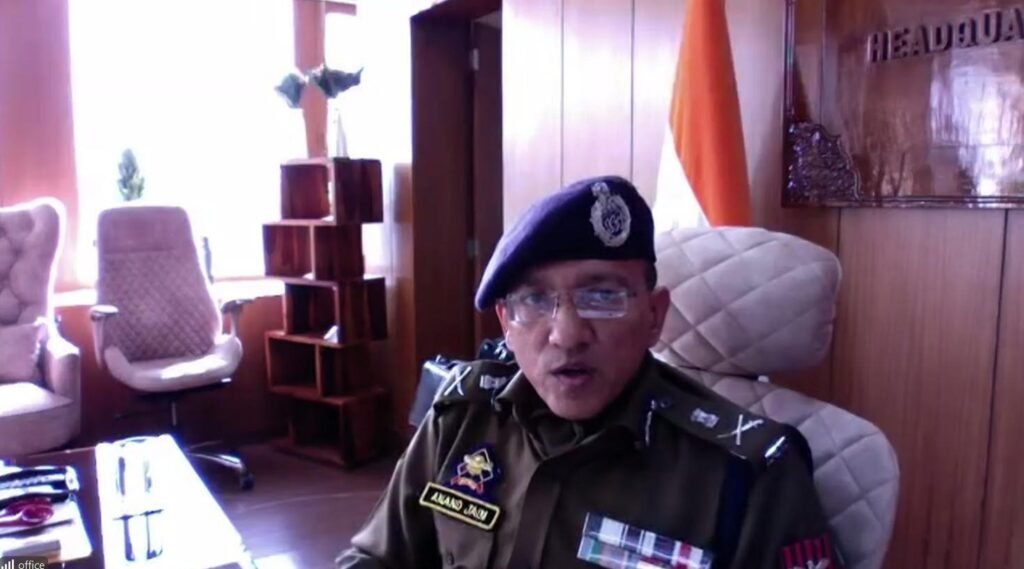
Jammu: The Department of Home Science (Human Development), University of Jammu, in collaboration with the National Institute of Social Defence (NISD), Ministry of Social Justice and Empowerment, Government of India, is organizing a two-day capacity-building workshop on “Convergence of Programmes for the Elimination of Beggary.”
Delivering the inaugural address, Anand Jain (IPS), Additional Director General of Police, Armed J&K, described beggary as a serious social concern that must be examined beyond conventional assumptions of poverty and disability.
He pointed to the increasing involvement of young children and able-bodied individuals, indicating that lack of skills, unwillingness to work, migration pressures, and possible organised group involvement are significant contributing factors.
Jain noted that the Jammu and Kashmir Prevention of Beggary Act, 1960, was struck down by the Jammu & Kashmir High Court in 2019, marking a shift away from criminalisation toward a welfare-based and rehabilitation-oriented approach.
He emphasised that sustainable solutions lie in structured rehabilitation, skill development, and social reintegration rather than punitive measures.
Referring to state-level initiatives such as the Rajasthan Rehabilitation of Beggars or Indigents Act, 2012 and Bihar’s Mukhyamantri Bhikshavriti Nivaran Yojana, he highlighted the absence of a comprehensive national law addressing beggary.
He advocated for the development of a Model Act that would enable the convergence of welfare schemes and coordinated action in Jammu and Kashmir.
The programme began with an introductory address by Prof. Sarika Manhas, Head, Department of Home Science, who emphasised the importance of the workshop in fostering inter-departmental convergence and strengthening collaborative mechanisms between law enforcement, welfare departments, academia, and civil society.
She highlighted that fragmented interventions often fail to produce sustainable rehabilitation outcomes and underscored the need for a humane, coordinated, and capability-based response.
Prof. Rajni Dhingra, Former Dean Research Studies, University of Jammu, also addressed the inaugural session, while Dr. Nitan Sharma, Faculty, The Law School, University of Jammu, presented the formal vote of thanks.
The workshop brought together 65 police officials, traffic police personnel, and representatives of Mission Vatsalya, J&K, members of voluntary organisations, faculty members, research scholars, and students to deliberate on strengthening coordination and sustainable rehabilitation strategies.
Three technical sessions were conducted later in the day, with Prof. Rajni Dhingra; Dr. Sapna Bansal, Associate Professor, School of Law, Forensic Justice and Policy Studies, National Forensic Sciences University, New Delhi; and Ranbireshwar Singh Jamwal (JKAS), CDPO, Dansal, serving as resource persons.DD

Correspondent Jammu