
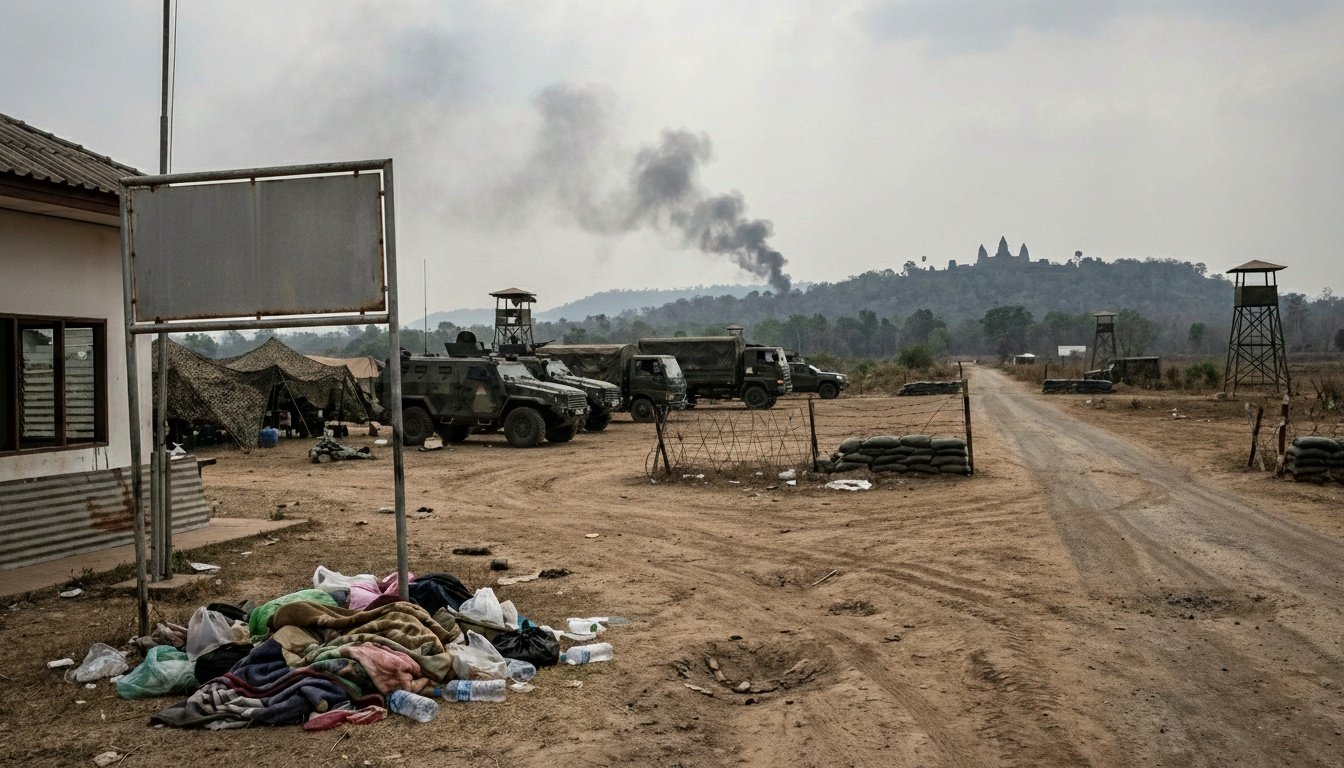

Analysis | Thailand–Cambodia: An Old Border Dispute Blows Past a New Peace Deal
Thailand’s airstrikes on Cambodian territory on 8 December are not a “new” conflict so much as the latest violent spike in a border dispute that has been festering for more than half a century — and that had, very recently, been wrapped in the language of peace accords and ASEAN diplomacy.
The uncomfortable truth is this: a Trump- and Malaysia-brokered framework briefly put a lid on the fire in 2025, but it never solved the fuel underneath it.
A Border Dispute With a Long Memory
At its core, the confrontation is the Cambodian–Thai border dispute, rooted in Franco–Siamese treaties from 1904 and 1907 and later shaped by Cold War frontlines. The most contested site is the Temple of Preah Vihear. The International Court of Justice (ICJ) ruled in 1962 that the temple itself belonged to Cambodia, but did not definitively settle the surrounding land. Later disputes, including fighting in 2008–2011, centred on temple zones such as Prasat Ta Muen Thom and Prasat Ta Krabey.
In 2013, the ICJ clarified that the promontory on which Preah Vihear stands lies in Cambodia — but like many border rulings in the region, the interpretation left enough grey area for politicians, militaries and nationalist movements to exploit.
Where maps are unclear, guns eventually redraw them.
How 2025 Escalated
The current crisis began earlier this year. Clashes in May and again in July resulted in deaths on both sides and forced mass civilian displacement. Reuters and regional media reported the July fighting as some of the most serious in more than a decade.
International intervention followed. Malaysia, then chairing ASEAN, worked with Washington to pressure both sides toward a truce. A ceasefire was signed in Putrajaya in late July, followed by the Kuala Lumpur Peace Accord in October — witnessed by U.S. President Donald Trump and Malaysia’s Prime Minister Anwar Ibrahim.
The agreement included commitments to withdraw heavy weapons, cooperate on demining, and allow ASEAN observers to monitor the frontier. It also included a roadmap for Thailand to release 18 captured Cambodian soldiers.
For a moment, the crisis looked containable.
The Landmine That Reopened the War
On 10 November, a Thai patrol triggered a landmine in Sisaket province. Thailand accused Cambodia of laying new mines in violation of the accord. Phnom Penh denied it, saying the explosive was a remnant from earlier decades of conflict.
Thailand responded by suspending implementation of the peace agreement. The ceasefire monitoring slowed. Border areas were remilitarised. Villagers on both sides were told to prepare for evacuation.
By early December, the peace deal was effectively frozen — not formally dead, but no longer functioning on the ground.
It took just one more spark.
Why Airstrikes — and Why Now
At dawn on 8 December, Thailand says Cambodian forces opened fire near the frontier, killing one Thai soldier and injuring eight others. Cambodia denies initiating the fighting.
Hours later, the Royal Thai Air Force deployed F-16s against Cambodian positions. Thai officials framed the airstrikes as “measured” and aimed at neutralising immediate threats. The operation represents one of the rare instances of an ASEAN member deploying air power against another in active conflict.
Cambodia claims it exercised restraint and accuses Thailand of escalating a situation that still could have been resolved diplomatically.
What is not disputed: civilians are being forced to run. The BBC reports more than 385,000 people evacuated on the Thai side. Cambodia confirms over 1,100 families displaced.
Border firefights have always been dangerous. This phase is strategic.
A Conflict That Keeps Returning to the Same Land
The geography of this crisis is no accident. The fighting continues near the same contested temple complexes and ridgeline terrain that have sparked clashes for decades. Those areas offer three things political actors on both sides recognise:
- Historic symbolism
- Ambiguous legal boundaries
- Military advantage
Combine those with domestic politics — leaders seeking strength, militaries asserting authority, nationalist narratives readily available — and the fragile peace collapses quickly.
ASEAN’s Limits Exposed
The crisis is also a test of ASEAN’s ability to manage conflict between its own members. It succeeded in brokering agreements — but enforcement is another matter. Observers withdrew from frontline areas as gunfire restarted. Statements urging restraint were issued. The airstrikes still happened.
The bloc’s foundational principle of “non-interference” becomes a liability when two member states are firing artillery across their border.
Diplomatic pressure may resume in the coming days, and both governments have signaled — at least rhetorically — that they are open to negotiations. But rhetoric rarely stops artillery.
What Comes Next
There are three immediate questions shaping what happens next:
- Will Thailand escalate or frame the airstrikes as the end of a single retaliatory cycle?
- Will Cambodia respond militarily, or continue positioning itself as the aggrieved but restrained party?
- Will ASEAN or U.S. diplomacy revive the stalled peace framework?
For now, the pattern is familiar: an ambiguous map, nationalist rhetoric, two armies in disputed territory — and civilians fleeing before politicians agree on language.
Ceasefires can pause violence. Borders decide whether it returns.
Right now, the border is deciding.

Anzer Ayoob is a journalist and author based in Jammu and Kashmir. He is the founder and current Editor in Chief of The Chenab Times. He is also president of Chenab Times Foundation, a registered charitable trust focused on art, culture and addressing public grievances.