
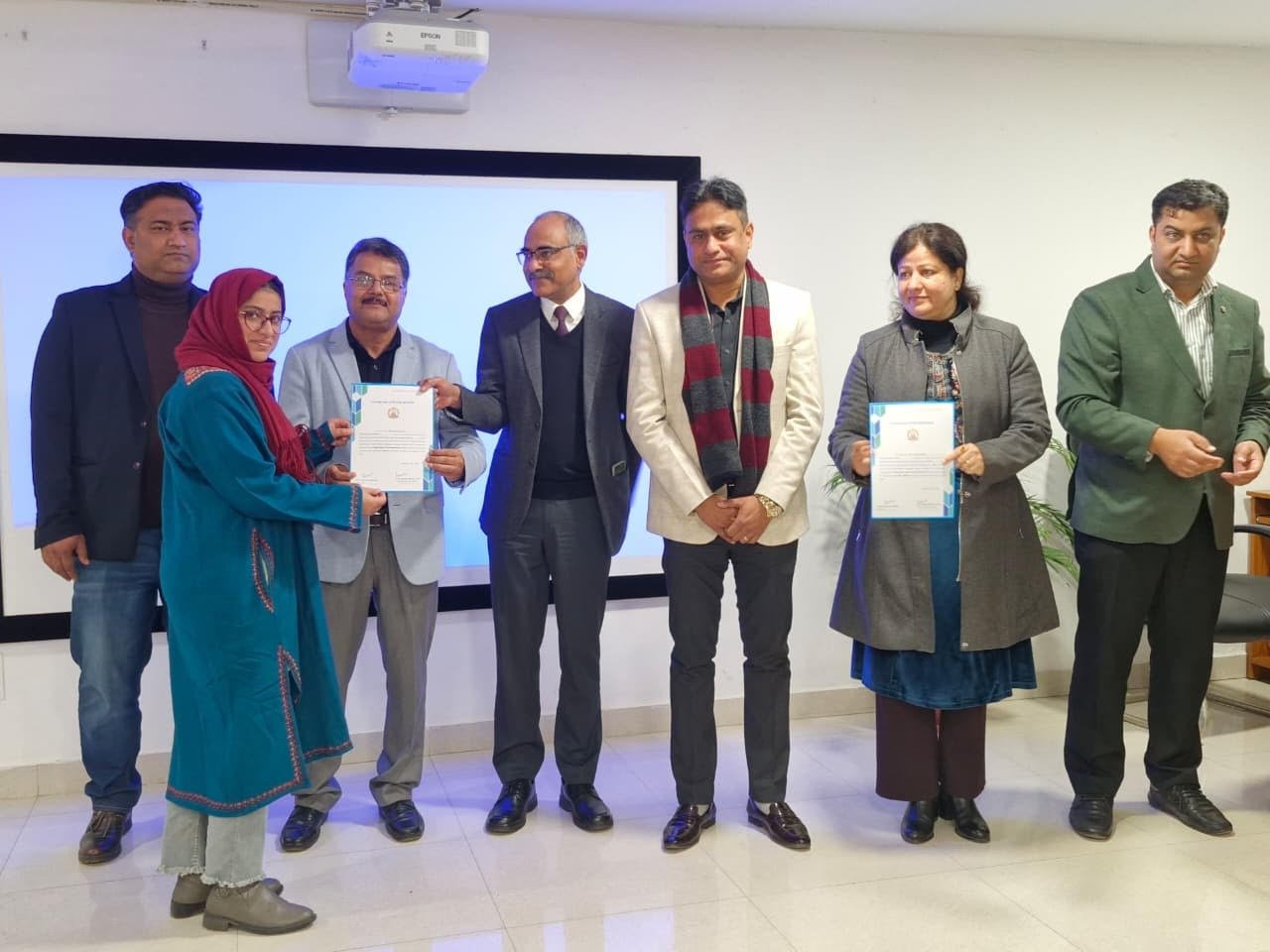
Jammu: The Department of Environmental Sciences, University of Jammu, held a detailed discussion on “Climate Change and Human Vulnerability: Bridging Science, Society, and Governance” during a one-week national capacity-building workshop on the campus.
The workshop was organized in collaboration with the Malviya Mission Teacher Training Centre (MMTTC), University of Jammu, and was funded under RUSA 2.0, with technical partnership from the Department of Ecology, Environment and Remote Sensing (DEERS), Government of Jammu and Kashmir.
The valedictory function was graced by Vasu Yadav, IFS, Principal Chief Conservator of Forests, Chairman, J&K Pollution Control Committee, and Director, DEERS, as the Chief Guest, while Dr. Sandeep Gupta, Regional Director, IGNOU Jammu, was the Guest of Honour. The function was presided over by Prof. Yashpal Sharma, Dean, Faculty of Life Sciences, and Rector, Udhampur Campus, University of Jammu.
Prof. Deepika Slathia, Convener and Head of the Department, formally welcomed the dignitaries and spoke at length about the growing urgency of climate change and its far-reaching implications for natural ecosystems, human livelihoods, and governance mechanisms. She expressed sincere gratitude to Prof. Umesh Rai, Vice-Chancellor; Prof. Sundeep Pandita, Director, MMTTC; and Prof. Satyapal, Coordinator, RUSA 2.0, for their valuable institutional and financial support.
Vasu Yadav lauded the department for its concerted efforts in the successful completion of the workshop. He highlighted the significance of interdisciplinary and capacity-building programmes in addressing climate change–induced vulnerabilities and reiterated his commitment to providing technical support to the department for similar endeavours in the future. Prof. Sharma emphasized the growing need to integrate traditional knowledge with modern science across disciplines to effectively tackle climate-related challenges. Dr. Gupta stressed the importance of introducing climate change as a dedicated academic discipline to equip students with the knowledge and skills required to develop sustainable solutions.
Dr. Rakesh Kumar, Organizing Secretary, presented a detailed workshop report and expressed sincere gratitude to the dignitaries, resource persons, and participants for their valuable contributions. He also appreciated the efforts of Dr. Majid Farooq and his team from DEERS for their pivotal role in facilitating field-based exercises and strengthening the policy relevance of the workshop deliberations.
The workshop received an overwhelming response, with around 60 participants drawn from across the country and the Union Territory of Jammu and Kashmir. Participants represented diverse academic disciplines, including Environmental Sciences, Geography, Geology, Political Science, Economics, Sociology, Literature, Chemistry, Engineering, and allied fields, enriching deliberations and promoting meaningful cross-disciplinary learning.
An eminent panel of resource persons from premier national institutions such as Jawaharlal Nehru University, New Delhi; IIT Jammu; Govind Ballabh Pant National Institute of Himalayan Environment (NIHE); Indian Council of Forestry Research and Education (ICFRE), Dehradun; TERI School of Advanced Studies, New Delhi; Council on Energy, Environment and Water (CEEW), New Delhi; WWF-India; University of Kashmir, and various government departments shared their expertise on themes including climate science, Himalayan ecology, vulnerability and risk assessment, climate governance, adaptation and mitigation strategies, climate finance, data analysis, and participatory methodologies.
A major highlight of the programme was its field-based component, which included visits to flood-affected villages in Jammu. Participants conducted field surveys and gained first-hand exposure to climate-induced vulnerabilities, adaptive practices, and livelihood risks, thereby strengthening the linkage between theoretical frameworks and ground realities. Participants noted that the workshop enhanced their conceptual clarity regarding climate change as a long-term and systemic phenomenon, along with improving practical skills in vulnerability assessment, data collection, analysis, and spatial mapping.
At the conclusion of the programme, the organisers emphasised that the workshop should be viewed not as an end but as a preparatory step towards sustained engagement with the challenges of climate change. Among those present on the occasion were Prof. Piyush Malaviya, Dr. Neeraj Sharma, Dr. Anshu Gupta, Dr. Suresh Kumar, Dr. Harish Dutt, Dr. Amit Singh, Dr. Alok Kumar, Dr. Jinee Gogoi, Dr. Vivek Gaurav, senior officials from the Forest Department, and faculty members and research scholars from various departments of the University.DD

Correspondent Jammu