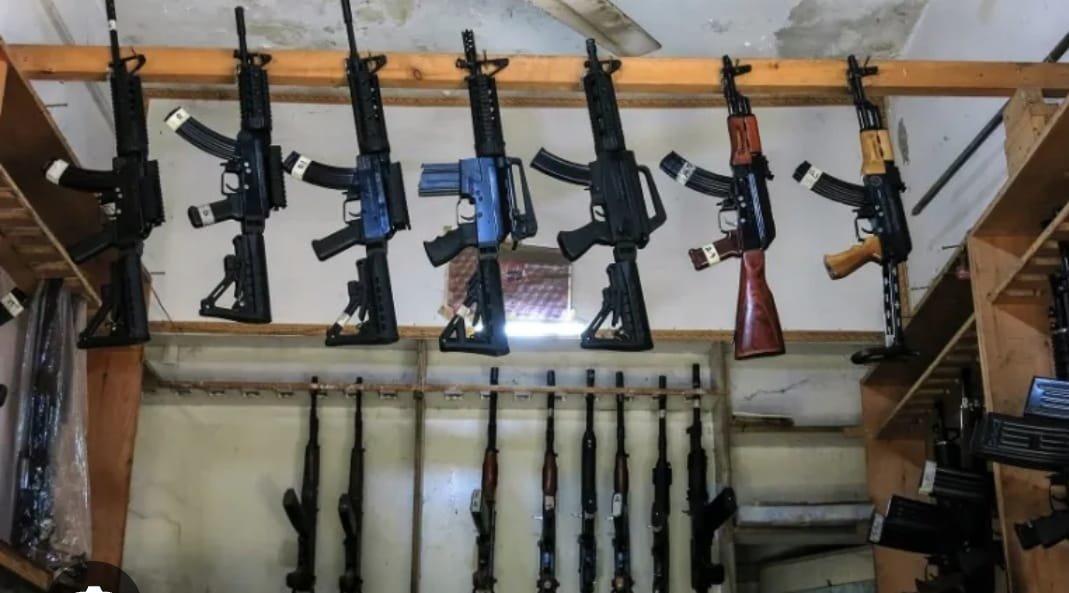
In a significant counter-terror breakthrough, security forces in Jammu & Kashmir recovered two “Darra Adam Khel–made” M4 rifles from a terrorist hideout in the Nougam Valley of Anantnag. The joint CRPF–SOG–Army operation also seized pistols, grenades and ammunition, but it is the origin of the rifles that signals a deeper strategic concern.
Darra Rifles Reflect Pakistan’s Eroding State Control
Darra Adam Khel in Pakistan’s Khyber Pakhtunkhwa region is globally known for its illicit gun-making workshops that replicate sophisticated weapons, often with surprising accuracy. The recovery of these rifles in Kashmir underscores a stark reality: the Pakistani state has virtually no writ in this tribal belt. As governance collapses and militant networks operate freely, weapons from Darra can now infiltrate the wider South Asian terror ecosystem, threatening India, Bangladesh, Nepal, Sri Lanka and even the Asian terror ecosystem, threatening India, Bangladesh, Nepal, Sri Lanka and even the Maldives, where Pakistani proxies have historically maintained footholds.
Internal Fault Lines within Pakistan’s Deep State
This development comes at a time when Pakistan’s military–intelligence apparatus is under unusual internal strain. The trial of Lt Gen (Retd.) Faiz Hameed, former ISI chief, has triggered rifts within the ISI and the wider military establishment. These fractures are believed to have weakened centralised control over militant organisations once tightly managed by ISI handlers. As command lines blur and factions compete, several networks may now be operating autonomously, enabling illegal weapons from KP to flow unchecked into Kashmir. An alternative viewpoint also suggests that US abandoned weapons are no longer coming from Afghanistan and Pakistan is constrained economically to use cheaper locally made weapons and ammunition.
Pakistan’s *Overstretched Security Forces and Risk of Diversionary Instability
Pakistan’s security forces are stretched thin due to escalating TTP attacks, unrest in Balochistan, sectarian tensions and political volatility. Historically, whenever the state faces internal pressure, diversionary instability in the region has been used to deflect domestic and global attention. The appearance of Darra-made M4 rifles in Kashmir could signal an attempt to revive such strategies using deniable, locally manufactured weapons.
India’s Strengthened Security Response
Following the recovery, security forces have intensified anti-terror operations across Jammu & Kashmir, focusing on OGW networks, infiltration routes, and deep reconnaissance. In the Jammu Region, area domination in hilly and rural belts has been expanded, Village Defence Groups (VDGs) strengthened, and police–public coordination enhanced to create a resilient security grid.
A Strategic Warning
The seizure of Darra-made rifles is more than an isolated find—it is a warning about Pakistan’s internal breakdown, its rogue weapons economy, and the resurgence of cross-border terror linkages. India’s proactive response reflects a clear understanding of this evolving threat landscape.DD

Geostrategic Analyst