
India suspends visa services at several centers, citing “unstable security environment”
Diplomat Foreign Desk
Dhaka: In a surprise turning of events in Bangladesh, violence erupted with a violent mob targeting the Indian Mission at Chittagong, escalating diplomatic and civil unrest in the country that saw toppling of previous Govt of Sheikh Hassina.
Hassina was given asylum by the Govt of India after her Govt was toppled by the violent mass-protests that installed Nobel laureate Dr. Muhammad Yunus as Chief Adviser of the interim Govt in Bangladesh.
As he took over the charge, and assured change in Bangladesh, the situation seemingly turned normal but the internal rift and political unrest could not be smelled that escalated all of a sudden following the killing of a youth.
The Death That Sparked Violence: The violence was ignited by the death of Sharif Osman Hadi, a prominent radical student leader and spokesperson for the Inqilab Mancha. Hadi had been a leading voice in the student – led uprising that toppled the previous regime and was known for his fierce anti – India rhetoric.
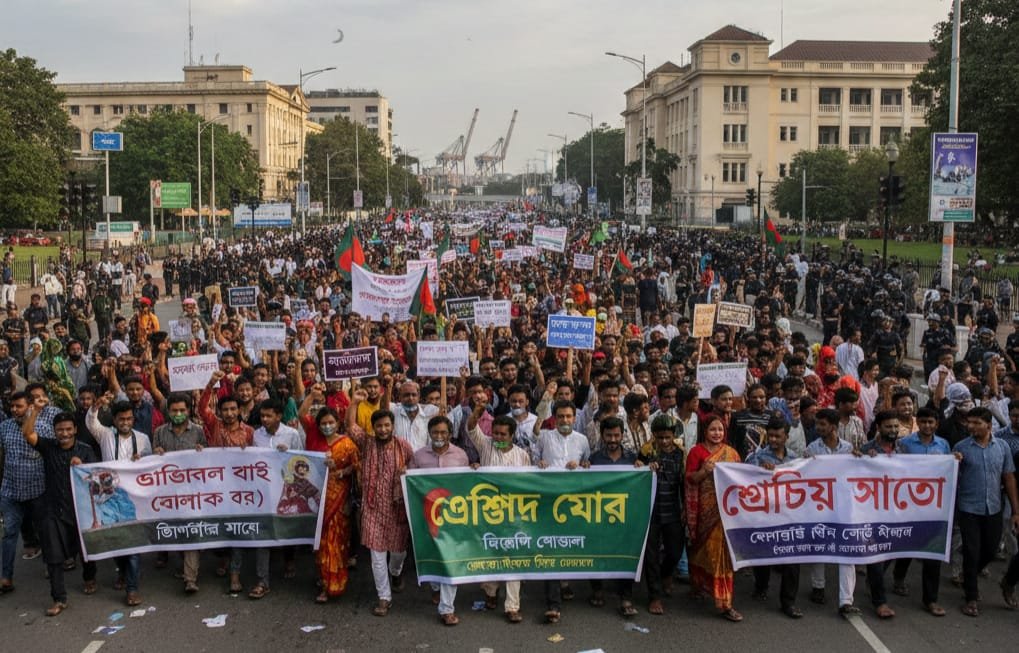
After being shot by masked assailants in Dhaka on December 12, Hadi was airlifted to Singapore for treatment. After his death on Thursday night, nationwide protests triggered, and people came on roads to express their rage. The radical groups and student activists quickly shifted the blame toward neighbouring country, India.
Chittagong’s Midnight Siege: Late night, the mob surrounded the Assistant High Commission and the nearby residences of Indian officials. The protesters pelted the building with bricks and stones, shattering windows and damaging the mission’s exterior.
Vandalism and Arson: Beyond the mission itself, the crowd targeted the residence of former Awami League minister Mohibul Hasan Chowdhury, setting a motorcycle on fire and attempting further arson.
Meanwhile, the Bangladeshi security forces, who were criticized by Indian observers for a “delayed response,” eventually intervened with tear gas and batons. The resulting “chase and counter – chase” left at least four people injured, including two police officers.
In the early hours of Friday, December 19, 2025, the port city of Chittagong became a flashpoint for escalating diplomatic and civil unrest in Bangladesh.
The situation continues to remain tense. The diplomatic relations between Bangladesh and India, especially in the emerging situation, becomes challenging.
A mob of several hundred protesters launched a violent assault on the Indian Assistant High Commission, marking one of the most direct provocations against Indian diplomatic staff since the fall of the Sheikh Hasina Govt.
Indian Staff’s Safety: Despite the intensity of the mob, the Ministry of External Affairs (MEA) confirmed that all Indian diplomats and mission staff in Chittagong were safe, though they remained under “siege –like” conditions for hours.
The Indian Govt has since expressed grave concern, summoning the Bangladeshi High Commissioner in New Delhi to demand enhanced security for all diplomatic outposts in the country.
Chittagong Incident Not Isolated: Similar attempts to storm Indian missions were reported in Dhaka, Rajshahi, and Khulna.
Importantly, in response to the volatility, India has suspended visa services at several centers, citing the “unstable security environment.”
Former Indian Diplomats have described the situation as an “orchestrated effort” by extremist elements to pressure the interim government and sour bilateral ties ahead of the February 2026 elections.
Existing Situation: Even as the interim government, led by Muhammad Yunus, has urged citizens to “resist mob violence” and declared a day of state mourning for Hadi, the atmosphere in Chittagong remains tense.
The heavy security cordons have been placed around Indian diplomatic assets. The safety of Indian personnel continues to be a primary strategic concern for New Delhi. (Agencies)