
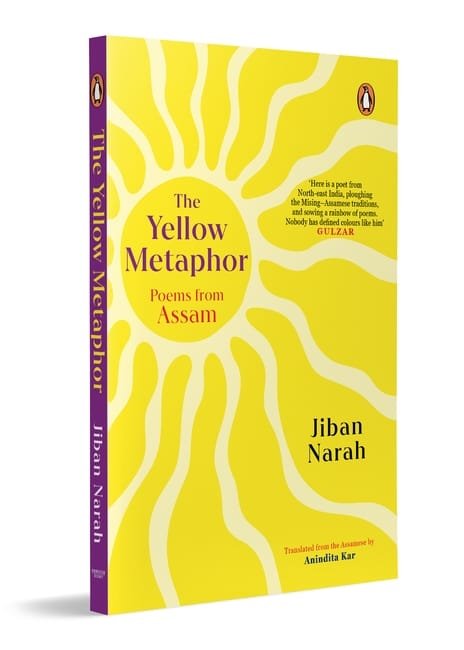
The Yellow Metaphor, a poetry collection by Jiban Narah published by Penguin Random House India and translated by Anindita Kar, encompasses works from 1990 to 2023. Its ninety-nine poems chart Narah’s personal and cultural evolution, deeply rooted in the riverscapes of Assam.
The collection’s use of colour, particularly yellow, is notable. Yellow functions not merely as ornamentation but as a vital force: it evokes the glitter of mustard fields, the ripeness of corn, and a luminosity that approaches the apocalyptic.
Narah renders metaphor tangible and visceral, manifesting on the page, in the body, and through the eye. This effect is most pronounced in passages where mustard “creeps into my eyes”, and beauty acquires a disquieting quality, as people stumble and cows wail by a stagnant pool. In these moments, yellow becomes overwhelming, animate, unsettling, and unforgettable.
Narah’s poetry reflects a layered world. As a bilingual and bicultural poet, he bridges the Mising community and Assamese traditions, drawing upon folk beliefs, myths, riverine life, and quotidian details. Scents descend like windblown fruit, rivers trace destinies along palm lines, and ants bear the weight of the world on their shoulders.
The imagery throughout the collection is tactile and sensuous: fingers imbued with the scent of corn, moonlight collected in a bowl of country liquor, and seeds of poems sown in ploughed earth by birds. These poems remain firmly anchored in corporeal and terrestrial experience.
The collection places particular emotional emphasis on family, especially the figure of the mother. One poem offers a stark portrayal of a woman who is vulnerable and isolated, drinking to numb her pain and speaking candidly about ageing.
In another, the mother assumes a philosophical role, engaging in a silent, dreamlike exchange with a dying Virginia Woolf. The rural mother’s voice contrasts with Woolf’s literary language, yet the dialogue remains urgent and deeply personal.
The omission of quotation marks allows the conversation to flow uninterrupted, compelling readers to discern the speaker. This formal decision underscores the poem’s cultural intersection.
Here, translation is not invisible. Kar openly addresses the challenges: conveying the music of Assamese lament, preserving unique terms like ‘smoked-potato village,’ and maintaining the onomatopoeic sounds of native melodies. She retains the strangeness of words such as karpungpuli (magical moonlight) and the unpolished names of ancestors and gods.
The result is an English that remains porous, allowing the original world to emerge. At times, the language may feel foreign or even jarring, but this sincerity reminds us we are guests in another language and culture.
The first poem, ‘Colours’, serves almost as a manifesto. Life is depicted as a loom, with the warp and weft spanning birth to death. Each colour marks a passage: green for childhood, red for an irreversible end. Narah’s imagination is vivid and elemental.
Elsewhere, colours express joy and sorrow; tears have colour; the moon becomes a bowl to be savoured. Narah’s rhythm is often hypnotic and fluid, as in the poem where a woman holds the evening in her palm, sips it, and darkness seeps into her eyelids until moonlight blooms on her skin like wildflowers.
The softness in the repetition of sounds – sips, swirls, seeps, spills, soaks – creates a gradual blooming effect, which the translation captures well. Narah writes from a society marked by ethnic diversity, marginalisation, exploitation, and instances of terrorism.
The voice is not only documentary; it remains lyrical, humanistic, and bound to joy, love, sex, the beauty of nature, and mystery. It does not easily separate the personal from the collective, or the local from the universal. According to the poet’s introduction, feelings such as sadness, desire, and fascination are universal among poets, whether writing in Malayalam, Bengali, Spanish, or French.
Context, perspective, and the unique threads of the translations remain technically faithful to the originals without becoming rigid. Although end-rhymes and internal musicality cannot be fully reproduced, the result is a new poetic music that is hypnotic, tactile, and grounded in sound and imagery.
The deliberate avoidance of unnecessary punctuation and capitalisation reflects the immediacy of the original texts. A glossary at the conclusion offers unobtrusive support for readers.
For readers unfamiliar with Assamese poetry, this book offers a window into a centuries-old tradition, from the mystical charyapada of the eleventh century and the devotional works of Sankardeva and Madhavadeva to contemporary and postmodern forms that maintain a humanistic foundation.
Narah belongs to this tradition, shaping something distinctly his own: sensuous, folk-laced, and unafraid of the shadows of the modern world. It is local and silent at the same time, where yellow is not merely a colour but a state of seeing—ripe, radiant, even blinding, forever alive.
This collection is essential reading for those interested in the diverse voices shaping contemporary Indian literature. It exemplifies the significance of crossing linguistic boundaries with both curiosity and attentiveness.DD

Contributor, Diplomat Digital