
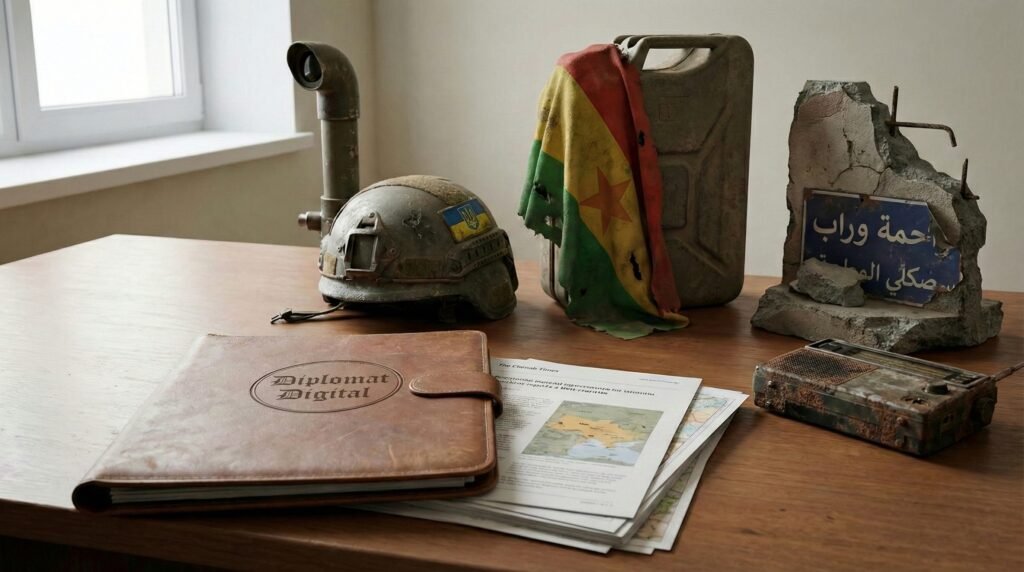
The year 2026 has begun with global security precariously balanced, as major conflicts in Eastern Europe, Africa, and the Middle East show few signs of resolution despite renewed diplomatic pressure and shifting geopolitical alignments.
According to details received by Diplomat Digital, intelligence assessments suggest that although some high-intensity combat has slowed into grinding wars of attrition, the risk of regional spillover—particularly in West Africa and the Levant—has reached alarming levels. Analysts warn that the simultaneous persistence of these conflicts is stretching international mediation efforts to their limits, leaving millions of civilians trapped in prolonged humanitarian crises.
Why this matters
The continuation of these conflicts into 2026 signals a deepening breakdown in traditional conflict-resolution mechanisms. The prolonged war in Ukraine continues to strain Western defense industries and energy markets, while the rapid expansion of jihadist violence in the Sahel threatens to destabilize coastal West African nations such as Benin and Togo—key economic hubs for the region. In the Middle East, the failure to achieve a permanent settlement keeps global oil shipping routes vulnerable and maintains a high risk of a broader regional confrontation involving major powers. Collectively, these hotspots contribute to a growing “polycrisis,” where displacement, economic turmoil, and radicalization reinforce one another.
In Eastern Europe, the Russia-Ukraine war has solidified into a “forever war” dynamic. By early 2026, Russian forces continue to hold roughly 20 percent of Ukrainian territory. The conflict is increasingly defined by entrenched defensive lines and large-scale drone warfare rather than major territorial shifts.
In Africa, the security architecture of the Sahel has been fundamentally reshaped. Military juntas in Mali, Burkina Faso, and Niger—after expelling Western forces in favor of Russian security partnerships—are failing to contain jihadist groups. Insurgencies that were once confined to the arid interior are now pushing south toward the Gulf of Guinea.
Meanwhile, the Middle East remains stuck in recurring cycles of violence. Fragile ceasefires in Gaza and Lebanon are repeatedly tested by clashes and proxy confrontations between Israel and Iran-aligned groups.
What is happening presently
On the ground, the situation remains fluid but largely deadlocked. In Ukraine, both sides are concentrating on striking critical infrastructure and logistics hubs behind the frontlines, acknowledging that a decisive breakthrough is unlikely in the near term.
In the Sahel, the collapse of cross-border security coordination has enabled groups such as JNIM (Jama’at Nasr al-Islam wal Muslimin) to consolidate control over rural regions, effectively besieging government-held towns.
In the Middle East, major combat operations in Gaza have reduced compared to previous years, yet a low-intensity conflict persists amid a dire humanitarian situation and minimal reconstruction. Tensions also remain high along Israel’s northern border, where sporadic exchanges with Hezbollah continue to displace communities on both sides.
International reaction reflects a mix of fatigue and urgency. The United Nations and humanitarian agencies have issued stark warnings that “global distraction” is allowing neglected crises—particularly in Sudan and the Sahel—to spiral out of control. Western policymakers are increasingly questioning the sustainability of current aid and security models, with the US administration facing pressure as it attempts to shift strategic focus away from the Middle East.
Observers note that without a renewed and unified diplomatic effort, 2026 is likely to see these conflicts persist and deepen, entrenching a global order marked by instability and fragmented security blocs.

Anzer Ayoob is a journalist and author based in Jammu and Kashmir. He is the founder and current Editor in Chief of The Chenab Times. He is also president of Chenab Times Foundation, a registered charitable trust focused on art, culture and addressing public grievances.