
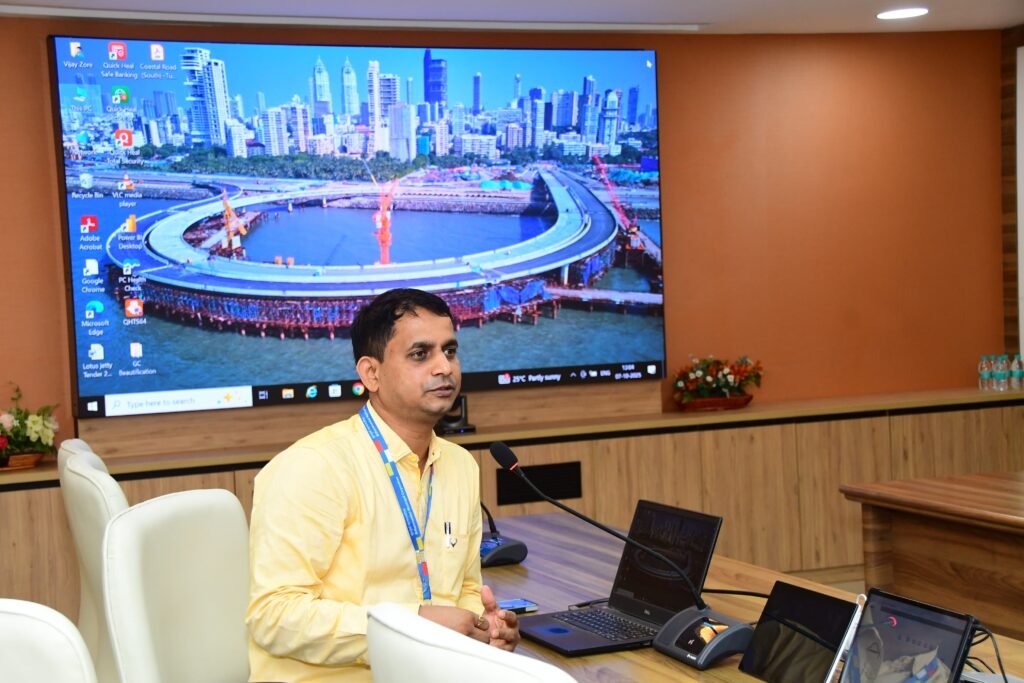
Engineer Vijay Zore briefs journalists on the ₹14,030 crore Mumbai Coastal Road Project (South), highlighting its design, sustainability, and role in redefining the city’s transport landscape.
Jaan Mohammad
Mumbai: DD: As part of the ongoing PIB J&K Media Tour to Mumbai, journalists from Jammu and Kashmir visited the Mumbai Coastal Road Project (South), where officials from the Brihanmumbai Municipal Corporation (BMC) briefed them on the key features, engineering innovations, and social-environmental initiatives of the project. The session was led by Engineer Vijay Zore, Coastal Road Project (South), BMC, who presented a comprehensive overview of the development, its challenges, and its expected long-term benefits for Mumbai’s citizens.
Engineer Vijay Zore informed that the Mumbai Coastal Road Project (South) is a state-of-the-art urban infrastructure initiative aimed at easing traffic congestion, reducing travel time, and creating new green spaces along Mumbai’s western coast. The project connects Princess Street Flyover (Marine Drive) to the Worli end of the Bandra–Worli Sea Link through a 10.58 km eight-lane corridor built along the Arabian Sea.
He said the total project cost stands at ₹14,030.11 crore, including ₹9,420.22 crore for construction and ₹4,609.89 crore for consultancy, contingencies, and utility shifting. The project was executed in three major packages awarded to Larsen & Toubro Ltd. and HCC-Hyundai JV under consultancy by AECOM, Egis India, Louis Berger, and Yooshin Engineering Corporation.
Mr. Zore briefed that the project consists of 4.35 km of reclaimed roadway, 2.19 km of bridges, and 2.07 km of twin bored tunnels (11 metres in diameter), along with three major interchanges located at Amarsons Garden, Haji Ali, and Worli. The tunnels have been constructed using India’s largest tunnel boring machine (12.19 metres) and are equipped with the first-ever Saccardo Ventilation System for vehicular tunnels in India.
He added that the project will reduce travel time between Marine Drive and Worli from 45 minutes to just 8 minutes, increase average speed from 21 kmph to 80 kmph, and save around 34% fuel consumption. The reduction in congestion will lower air and noise pollution, cutting approximately 1,826 tons of carbon dioxide emissions annually. The road is completely toll-free and designed to serve as a world-class urban corridor integrating environmental and recreational components.
Mr. Zore highlighted that 70 hectares of landscaped public space and 7.5 km of promenade have been created along the coast, featuring jogging and cycling tracks, children’s play areas, and butterfly gardens. The project also includes four multi-level parking lots with a combined capacity of about 1,800 vehicles.
Discussing environmental safeguards, he said coral colonies identified near Worli and Haji Ali were successfully translocated by the National Institute of Oceanography (NIO) under CSIR, achieving a 90% survival rate. The project uses natural armour rocks for the seawall to prevent erosion and protect the coastline from storm surges and high tides.
The engineer also explained that the project features a fully automated Traffic Management and Control System (TMCS) located at Amarsons Garden Integrated Control Centre. The system integrates CCTV surveillance, emergency communication lines, meteorological data, and coordination with BMC’s Disaster Management Department, police, and fire brigade for real-time traffic and incident management.
He said the Coastal Road Project is a landmark in engineering innovation, introducing the first Bow-String Arch Bridge in India (2,400 metric tons, 136-metre span installed with the float-over method) and the first monopile foundation system for marine bridge construction.
Mr. Zore informed that the south corridor became fully operational on 15 August 2025, with both northbound and southbound traffic running 24×7 between Marine Drive and the Bandra–Worli Sea Link. He added that landscaping and promenade maintenance have been undertaken by Reliance Foundation, while Tata Power has developed median plantations under CSR initiatives.
Background:
The concept of the Coastal Road Project dates back to the 1967 Development Plan and was reaffirmed in the 2034 Mumbai Development Plan. The Government of Maharashtra constituted a Joint Technical Committee in 2011 under the then Municipal Commissioner Shri Subodh Kumar to assess traffic solutions for Mumbai’s western coastline. The committee recommended a 35.6 km coastal road integrating roads, bridges, tunnels, and recreational open spaces for sustainable urban mobility.
Key Facts:
- Total project length: 10.58 kilometres.
- Project cost: ₹14,030.11 crore.
- Commencement date: October 2018.
- Completion date: May 2025.
- Construction cost: ₹9,420.22 crore; other costs: ₹4,609.89 crore.
- Road configuration: 8 lanes (4 + 4); twin tunnels with 6 lanes (3 + 3).
- Total reclaimed land: 111 hectares.
- Green and recreational spaces: 70 hectares.
- Promenade length: 7.5 kilometres.
- Tunnel diameter: external 12.19 metres, internal 11 metres.
- Interchanges: Amarsons Garden, Haji Ali, and Worli.
- Travel time reduction: from 45 minutes to 8 minutes.
- Average speed increase: from 21 kmph to 80 kmph.
- Fuel saving: approximately 34%.
- Annual carbon reduction: 1,826 tons of CO₂.
- Parking capacity: about 1,800 cars.
- Employment generated: thousands of skilled and unskilled jobs.
- Coral translocation success rate: 90%.
- Landscape development partner: Reliance Foundation.
- Median greening partner: Tata Power Ltd.
This visit formed part of the five-day PIB J&K Media Tour, organized under the leadership of Ms. Neha Jalali, Director, PIB Jammu, and facilitated by Ms. Jaidevi Pujari Swami, Deputy Director, PIB Mumbai. The delegation includes 14 journalists from Jammu and Srinagar who are visiting key national projects and institutions to gain insights into India’s development and infrastructure initiatives.DD