
Diplomat Special Correspondent
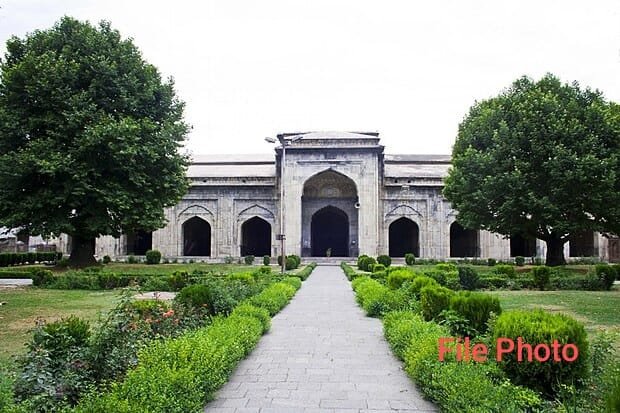
Srinagar, (DD): Nestled in the heart of Srinagar’s historic downtown, Pathar Masjid, (stone mosque) stands as a silent witness to centuries of cultural transformation and religious devotion.
This 14th-century structure, built by Sultan Sikandar, not only embodies the architectural brilliance of Kashmir’s past but also holds a deep spiritual significance for the people of the Valley.
The mosque, whose name translates to “Stone Mosque” in Urdu, is renowned for its unique stone construction, a rare feature that sets it apart from other mosques in the area. Its intricate carvings, elevated platform, and serene courtyards reflect the finesse of Kashmir’s medieval architecture.
As we step into the narrow lanes of Downtown Srinagar, a community steeped in history and tradition, elderly locals gather to share their memories of the mosque. Their stories paint a vivid picture of how the mosque has shaped the lives of many generations.
“Pathar Masjid has been a part of our lives for as long as I can remember,” says Syed Bashir, an 85-year-old local resident of the area. “My father, his father before him, and countless others, have prayed here. It is more than just a mosque; it’s a symbol of our heritage.” His voice carries the weight of history, and his words reflect the reverence with which locals regard this landmark.
Built by Sultan Sikandar, also known as the “Iconoclast King” for his policies during the 14th century, Pathar Masjid was constructed to symbolize the grandeur of Islam in Kashmir. According to historical records, Sikandar was a monarch who not only influenced the region politically but also left his mark on its cultural landscape.
“Many people say the mosque was built to make a statement—standing tall as a testament to the growing influence of Islam in the valley. What we know for sure is that it is a part of our collective memory,” says Ghulam Mohammad, a 70-year-old historian from the area.
The mosque’s quiet, understated beauty provides a peaceful refuge in the midst of the chaotic streets of Downtown. For decades, it has served as a spiritual home for locals, a place to reflect, connect, and find solace.
Shazia Begum, a woman in her 60s, recalls how her family has been tied to the mosque for generations. “My great-grandfather was one of the first people to pray here after it was built,” she says. “It was not just a place of worship but also where people gathered for community discussions, socializing, and sharing news. Even today, you’ll see the elderly sitting in the courtyard after prayers, exchanging stories.”
The mosque also stands as a testament to the blending of religious practices in Kashmir. While Pathar Masjid has predominantly been a Muslim place of worship, it stands within a neighborhood where religious diversity is celebrated. Over the centuries, the mosque has been a focal point for interfaith dialogue, even though the political climate in the region has shifted drastically.
The mosque’s distinctive stone architecture is another reason for its fame. “Look at these walls,” says Farooq Ahmad, a local architect. “The beauty of the stonework is unmatched in Kashmir’s architecture. It’s not just the shape or the carvings; it’s the way the mosque blends into the landscape of the city. Even after all these years, the structure remains strong, just like our faith.”
The simplicity of the mosque’s design, combined with the artistic touches in its stone walls, makes it a striking example of Kashmir’s medieval architecture. Over the years, however, like many historical sites in the valley, Pathar Masjid has faced neglect and damage due to various socio-political challenges. Yet, its resilience is undeniable.
“Every time a challenge strikes Kashmir, the mosque stands firm,” says Muhammad Yousuf, a former government official in his late 70s. “It represents the enduring spirit of our people.”
Despite the passage of time and the shifting political and social landscapes, Pathar Masjid remains a vital part of Srinagar’s identity. For the younger generation, the mosque is not just a historical monument; it’s a bridge between the past and the present.
Zahra Ali, a young university student, speaks about how Pathar Masjid is a place for reflection and peace. “In the hustle and bustle of today’s world, places like these remind us of our roots. It’s important that we preserve these symbols of our heritage, not just for us but for future generations.”
The mosque has weathered many storms, both literal and figurative, over the centuries. Today, it stands not just as a place of worship but as a cultural symbol, representing the resilience and strength of the people of Srinagar.
Pathar Masjid, though quiet in its stance, continues to play a pivotal role in the lives of those who live in its shadow. As it faces the modern-day challenges of urbanization and changing times, it remains steadfast as a beacon of Kashmir’s rich history, spirituality, and resilience.
For those who visit, whether from near or afar, the mosque offers not only a glimpse into the past but also a vision of the future — one where tradition and modernity can coexist in harmony.(DD)