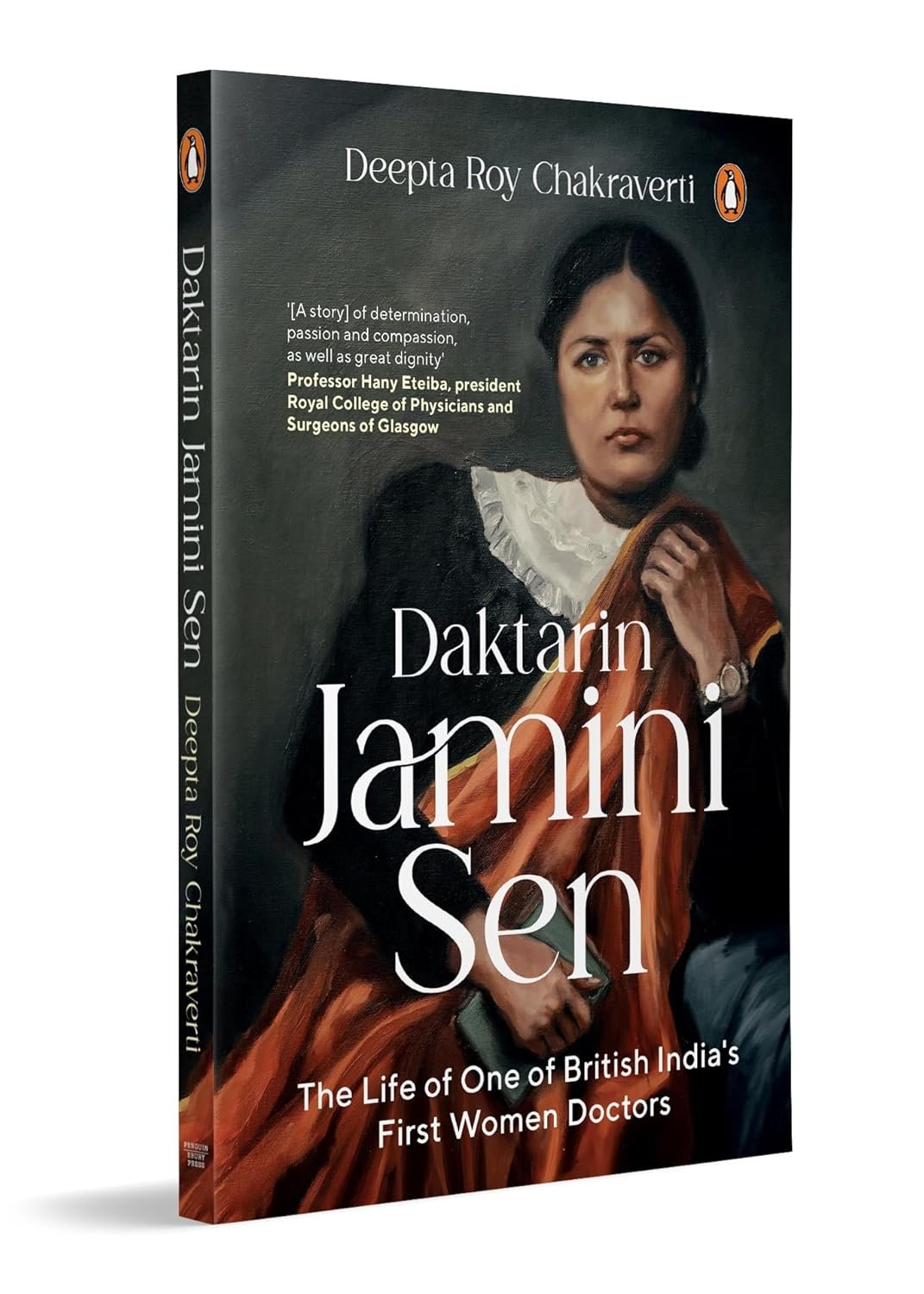
The lost case of Dr Jamini Sen, one of the first women doctors in British India, is revived in Daktarin Jamini Sen: The Life of One of British India’s First Women Doctors by Deepta Roy Chakraverti in Penguin Random House India, with scrupulous details and with a touch of pathos. It is a biography and a sort of act of reclamation, a stubborn effort to get Sen back into her proper niche in the pantheon of those who have made modern India what it is.
Based on family stories, rare Bengali biographies of Kamini Roy and Saradasundari Devi, her own writings, and archival fragments, Chakraverti creates a story that is simultaneously personal and historically multifaceted, which combines the family and the nation, the personal and the political.
The book opens with a note by the author that preconditions the scaffold of facts in the book. Chakraverti admits that she was obligated to rely on a short biography of Kamini Roy, Daktar Kumari Jamini Sen, which details important information about where Jamini had worked in Agra, Akola, Shimla, Shikarpur, Bettiah and Puri, and her work at Baldeodas Maternity Home.
Passages of Jamini’s own journal, of her letters regarding her journey back to India on hearing of the death of Bhutu, give reality and immediacy to the story. The writer also uses another work by Saradasundari Devi, Keshub Janani, to track the family ties and the same parchment by Jamini herself, Mahila Parishad, to shed some light on her experience of staying in a hostel in Berlin and her friendship with a young American girl. The combination of these sources, along with oral histories transmitted by the maternal line of Chakraverti, makes the text feel very textured and, at the same time, very personal.
The prologue presents Jamini Sen not as a historical figure but as a living being in the consciousness of the author. Chakraverti remembers that her grandmother, Roma and mother, Ipsita, had told her about Jamini, and the more she got to know about her, the more Jamini appeared to her as a heroine of some other age.
But there is beneath the admiration a trace of injustice: why had so bold and successful a woman been forgotten and relegated to a footnote in history? It is the result of this insurrection against obliteration, the unwillingness to make the story of Jamini fade away into the shadows. The fact that Jamini still has her old possessions, which are family heirlooms, is a treasure trove of the past, and the extra details of intimacy to the story.
The irony that India forgot her, but Scotland did not, is underscored by the fact that Jamini is currently being supported by the Royal College of Physicians and Surgeons of Glasgow, which has gone ahead to award her to this day as its first female fellow.
The story is developed in a great sense of the political and cultural background under which Jamini worked and lived. The years she spent in Nepal, in particular, are not only described as the time when she achieved professional success but also explored the political scene.
This was because Jamini was not only a valuable but also vulnerable person, being close to the royal family as she was, and the Prime Minister, Chandra Shumsher Jung Bahadur Rana, was particularly keeping a close watch on her. The book points to the way Jamini was taught to be discreet and astute in dealing with issues that might have political consequences, a skill that would be very useful in her career.
She was still an object of interest even when she left Nepal, and in 1931 rumours indicated that the Bhim Shumsher Jung Bahadur Rana was asking about her activities when he visited Calcutta. These incidents demonstrate how far Jamini’s life has come in crossing the line of power and politics in South Asia.
The afterword and epilogue reinforce the feeling of Jamini living a coded life, one that needs to be solved using family stories, oral history and concealed hints in the writings of Kamini Roy.
The fact that Kamini was concerned about the safety of the family since Jamini had died in 1932, made him write a synopsized biography which concealed and revealed at the same time. In complimenting Chandra Shumsher on her liking of Jamini, she thus attempted to keep off the unfriendly eye, but she also left extracts of the letters of Jamini, which were more suggestive of an unbroken connection with Nepal.
This two-sidedness concealment-revelation is the essence of the story of Jamini, which at times seems to be a mask concealing more dramatic realities. The book does not deny the fact that Jamini herself experienced the pressure of fate not being part of her life and that she was the sole cause of extremes of happiness and tragedy. However, Chakraverti declares that her life was to be filled with destiny, and this conviction makes the biography more of a history and less of a spiritual piece.
The fact that the book does not reduce Jamini to a one-dimensional character is what makes the book interesting to read. She is depicted as a progressive and ruthless but also a human being, prone to depression and scepticism. Her successes, becoming one of the first female doctors in British India, being a fellow, working in India and other countries, are offset by personal losses, political suspicions and the weight of womanhood in a patriarchal society.
The contradictions of Jamini as an insider and outsider, a celebrated and a forgotten, a strong and a wounded person, are not evaded in the story. This intricacy makes her narrative pertinent to more than historical context and speaks to the fight for recognition and justice in modern times.
The poetry has the rhythm of recollection and recovery. Chakraverti does not write as an objective historian but as an heir who is recovering a heritage. This view adds a dramatic touch to the book, and it is not just a biography but a family and cultural memory.
The mixture of personal voice and historical detail produces a style of narration that is both informative and authoritative, academic but personal. Reading becomes involved in the search for the author, feeling his discovery and indignation, his happiness to find some secret hints and upset of erasure.
The book also poses more general questions regarding the process of remembering and forgetting history. Why are certain personalities becoming famous and others disappearing? How do gender, politics and convenience impact collective memory? The narrative of Jamini is a good example of how inconvenient lives, the ones that go against the norms or come within the sensitive political situations, can be pushed to the background.
However, the very process of writing, of reclaiming, is a sort of resistance toward this erasure. The strength of the story is in the thoroughness of its origin, the way in which it manages to connect seemingly unrelated strands into a sensible tapestry. The book offers Bengali biographies, family treasures, works by Jamini herself, and the annals of the institutions in Glasgow. The book lists numerous sources that help to overcome the gap in history and restore a life that had fallen between the fissures.
This approach is indicative of the issues of writing women’s history in South Asia, where archival silence is the rule and oral traditions are burdened with the responsibility of preservation. In his work, Chakraverti illustrates that such silences may be filled in, that concealed hints may be overcome, and that lost lives may be brought back into the light.
The book itself is a celebration of the strength of hard work and legacy. Jamini Sen is not only an innovative doctor but also a figure of bravery, tact, and persistence. Her life, which is characterised by great heights of fame and famelessness, success and tragedy, turns out to be a reflection of the plight of millions of women whose work has not been recognised.
The book reclaims her life and encourages the reader to consider the greater trends of erasure and memory, and calls on a more inclusive and subtle interpretation of history.
To sum up, Daktarin Jamini Sen: The Life of One of the First Women Doctors of British India by Deepta Roy Chakraverti, published by Penguin Random House India, is a potent gesture of remembering and repossessing. It brings to light a woman whose life was touched to a significant degree by medicine, politics, and culture, although she is forgotten by her own country.
The book unravels the encrypted story of the life of Jamini through careful research and use of personal voice, which not only brings out her strengths but also her weaknesses. It is a biography that transcends the object that it deals with, and is addressed to the politics of memory, the strength of the female, and the call to acknowledge the unremembered legacies. By so doing, it guarantees that Jamini Sen is not in the background any longer, but a bright sun in the history of modern India.DD
Contributor, Diplomat Digital