
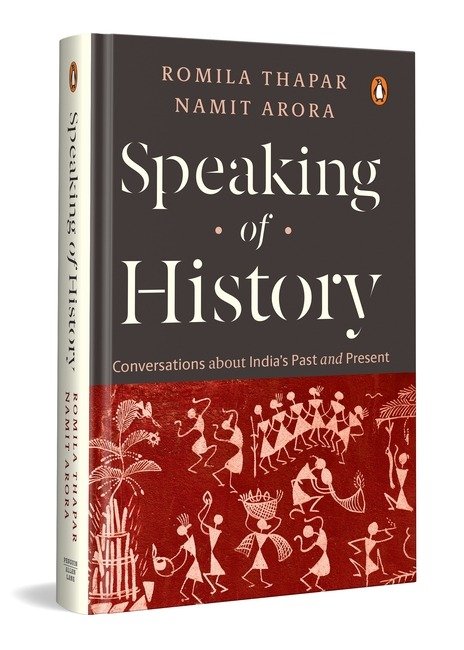
New Delhi: India, Past and Present, a compilation of the works of historian Romila Thapar and writer Namit Arora, published in 2025 by Penguin India, is not a typical book about history.
It is rather a collection of conversations, open, questioning, and thought-provoking, that attempt to come to terms with the writing, recalling, and disputing of history. What comes out is an erudite and entertaining text, a book that dares to subvert distortion and myth-making and glorifies curiosity and critical thinking.
The extracts display a project designed not so much like a textbook as like a living-room discussion. Thapar and Arora are not attempting to do the vagina of a broad survey, nor the thickness of a specialist monograph.
They are intended to awaken curiosity, to invite the reader to make his own discoveries, to ask himself what renders history trustworthy and why trustworthiness is significant.
The preface sets the tone. Thapar recalls a chance conversation with Arora about why history is usually misinterpreted. That discussion expanded into long debates over how the past was read in pre-modern India, how colonialist historians wrote early histories, and how nationalist historians responded.
The book places Indian historiography in the context of wider intellectual trends and the way in which the field shifted into the social sciences and embraced rigorous methods of evidence and analysis.
The authors are unashamed of the threats of pseudo-history. They observe how untutored authors have created utopian pictures of the past, mixing myth and fantasy, and passing them off as historical reality.
It is such narratives, they contend, that have led to an increase in distortion and fabrication. It is against this context that the book exemplifies the historical method, the systematic assessment of evidence, the rational formulation of cause and effect, and a consciousness of historiography as the nearest approach to a gold standard in good scholarship.
These themes are extended in the introduction. Thapar and Arora also explain the postmodernist critique that developed scepticism about the objectivity of history. Although Thapar is not a postmodernist, her studies acknowledge subjectivity, social context, identity, and power relations in the analysis of the past.
The example of her book Somanatha: The Many Voices of a History is given, in which social memory is shown to differ from the historical record, thus illustrating the interaction of storytelling and power.
The conversations also indicate how newer generations of scholars are developing sociocultural history. They are experimenting with caste, tribe, gender, faith, sexuality, and genetics, and posing radical questions through the lenses of marginalised voices, they are asking-Ambedkarite, adivasi, transgender, subaltern. These researchers are questioning the excessive emphasis on elite communities and re-evaluating the impact of power and knowledge on Indian society.
Intellectual interest is not lost by Thapar. She insists that all knowledge must be doubted and reminds readers that no historian should have his/her interpretations carved in stone. The book emphasizes the need for history to progress empirically and rationally, and that it should be informed by facts rather than ideology.
The authors also introduce art to enhance the story. Thapar proposes to focus on Adivasi and Tantric art forms that appear to be based on distinct social values and imaginaries, rather than on classical sculpture and painting. These choices, influenced by subjectivity and accessibility, help the reader remember that Indian culture is vast and diverse, and that there are numerous artistic worlds beyond the mainstream.
The discussions do not lack digression. In some instances, there are variations in knowledge, assumptions, or generational perspective, thus resulting in opposite views. But Thapar answers in his patient way and asks for more subtlety, more openness, and a broader appeal to evidence.
To Arora, these interactions were so engaging: a communal educational process that opened up intricate concepts without sacrificing intellectual authority.
The credits indicate the teamwork on the project. Contributions are made by literary agents, editors, designers, and legal reviewers. Publication of the book was made possible with the help of Penguin Random House India and Three Essays Collective, enabling it to reach domestic and international markets.
The back cover blurb encapsulates it in a nutshell: it is a book that tears the veil of concealment off the way things are done in the historians’ profession, the way things are interpreted, and why the past has now been turned into a political and identity war.
Caste and gender, mythology, and nationalism are some of the territories that the authors retrace, and pose crucial questions: what do we really know about our past, and why do we care about it so much today?
The interesting aspect of the book is that it does not offer history as a definitive fact. It views history as an inquiry rather than as a continuing dialogue informed by evidence, interpretation, and debate. It recognises the prejudices and pressures that train historians, but dictates that intelligent scholarship can reduce distortion.
The book is a good source for students and scholars as it provides information on the history of historiography, methodology, and writing of Indian historical literature. As a layman, it is pleasantly approachable, drawing them into the discussions which are both intellectually sound and personally involving.DD
Contributor, Diplomat Digital