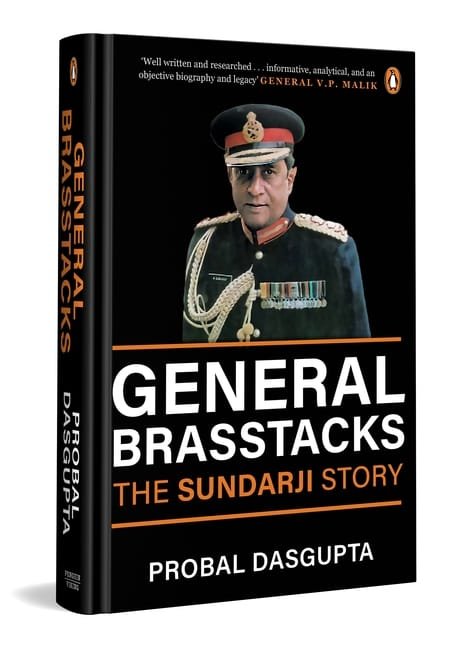
Few other military leaders in the history of post-independent India have created as much awe, discussion, and controversy as General Krishnaswamy Sundarji. His 40 years of service in the first 60 years of free India were marked by successes, failures, and ambitious plans to modernise the military.
‘General Brasstacks: The Sundarji Story’ (Penguin Books) by Probal Das Gupta is a detailed, scholarly yet easy-to-read account of his life that blends personal anecdotes, professional accomplishments, and tactical insights to render a portrait of a man who was both a visionary and flawed.
From the beginning, Sundarji’s career was a reflection of the nation. He attended the funeral of Mahatma Gandhi, saved refugees in Partition, and hoisted the tricolour on Pakistani soil on the first Independence Day. These childhood experiences influenced his ideas about responsibility and his faith in the army as one of the main pillars of Indian democracy.
As the decades passed, he was one of the architects of doctrines aimed at training the Indian Army to engage in modern warfare, nuclear realities, and the challenges of regional geopolitics.
The book highlights the audacity of Sundarji’s intellect. He was one of the first to claim that technology would be a force multiplier with computerised war games in the 1980s and advocate for jointness between the army, navy, and air force.
His focus on dogma and clarity of aim was out of the ordinary in a system that could be hard to change. Juvenile officers liked his charisma and wit, and senior officers respected his foresight despite his impatience and intolerance to dissent.
However, the story is not afraid of his mistakes. Brasstacks and Sumdorong Chu, Siachen are moderated by the failure of the Operation Blue Star calculation, the Bofors scandal, and the Sri Lankan intervention.
His critics charged him with being more intellectual than practical, a lack of infantry experience, and imposing reforms on the institution before it could take them in. Was he too ambitious in the system he would reform? Did his arrogance cover his success? These are asked with scholarly rigour, thus allowing readers to wrestle with the intricacy of his legacy.
The epilogue gives us a compilation of graphic personal experiences that make the general human. He grew cauliflower in cantonment gardens, played board games with his kids, and took his son fishing. His stepdaughter remembers his devotion to the care of roses while he was a partial paraplegic.
Brigadier Zaki recalls his quick retort and his ability to connect with junior officers, while Major General Jagatbir Singh narrates the story of Sundarji, an optics-conscious general who decided to have a photograph of a tank only after verifying that it had not been part of Operation Blue Star. These snatches show the reader a man who was not only a strategist but also a father, a teacher, and one who found comfort in nature and conversation.
Another theme examined in the biography is Sundarji’s post-retirement vision for India’s security situation. He had sounded warnings in lectures and in writing, sounding warnings of the consistent designs of Pakistan on Kashmir, the strategic ascendancy of China, and the threats of poverty and domestic instability.
His policies were those of discouraging deterrence toward Pakistan and dominance in tactics toward China, since they were two different threats. He not only perceives China as a competitor but also as a civilisation with an aspiration to become a member of the world power elite.
He foresaw his appreciation of fissile material stockpile, nuclear terrorism, and the necessity of force restructuring.
His critics, however, were vocal. Others who served in Sri Lanka claimed that he had no experience with infantry and was too theoretical. The rest charged him with being big and blatant. However, his most bitter critics acknowledged that there was no other general with his intellectual depth or desire to change the army.
The last chapters reflect on how Sundarji’s ideas have become outdated. His appeal to unanimity between the services, which was formerly extreme, has become dogma. His focus on technology and strategic clarity has influenced contemporary thought on military.
Nevertheless, his defeats in both conventional warfare and counterinsurgency are cautionary tales.
What is interesting about this biography is that it does not turn Sundarji into a hero or a villain. It portrays him as a man of contradictions, a visionary, flawed, cerebral, theatrical, reformist, and authoritarian.
His legacy is not easily summed up, since it continues to unfold. The questions Sundarji posed about doctrine, deterrence, and democratic accountability are pressing as India still seeks its place in a deeply unsettled world.
Sundarji is also placed in the context of the Indian Army’s history in the book. Sundarji crossed the path of India’s political and cultural development through the Charyapada traditions of Assamese poetry, the wars of 1965 and 1971, and the nuclear debates of the 1980s.
His contribution to the development of nuclear thinking, his interest in civil-military relations, and his insistence on India’s position as a regional power underscore the broader importance of his work beyond the battlefield.
The strength of the biography is its ability to combine the personal and the political. It reveals how the personal life of Sundarji, his gardening, his photography, his family games, was connected with his working dream.
It unveils the role of his intellectual interests, his impatience with stagnation, and his readiness to pursue unconventional views, which predetermined both his achievements and his downfalls.
This is not a military biography; it is a book on leadership, ambition, and the price of change. It is a must-read for anyone studying defence or military history, and for those seeking the interconnection between military strategy and national identity.

Contributor, Diplomat Digital