
‘De-facto Partition of Country with RSF largely controlling Darfur and SAF Consolidating Power in East, Centered Around Port-Sudan’
Diplomat Foreign Desk
Khartoum: Sudan, a land rich in history and potential, has for decades been a country defined by internal strife, political volatility, and devastating humanitarian crises.
The story of modern Sudan is a tragic tapestry woven with threads of civil war, genocide, military coups, and a constant struggle for democracy and stability.
Roots of Instability:
Sudan’s long-standing problems predate its current crisis, reaching back to its post-colonial period in 1956. Deep ethnic, religious, and economic divides historically separated the mainly Arab and Muslim northern region from the predominantly Christian or Animist southern region. These tensions erupted into two devastating civil wars (1955–1972 and 1983–2005), which claimed an estimated 1.5 million lives and ultimately led to the secession of South Sudan in 2011.
The political landscape was further shaped by the 30-year dictatorship of Omar al-Bashir, who seized power in a 1989 coup.
2003’s Darfur Genocide:
Under Bashir’s rule, the western region of Darfur exploded into conflict in 2003 when non-Arab rebel groups launched an insurgency against the government. In response, the government armed and unleashed the notorious Janjaweed militias (later reformed into the Rapid Support Forces or RSF). This conflict led to widespread atrocities, mass displacement, sexual violence, and ethnic cleansing, which the US determined amounted to genocide. Hundreds of thousands were killed, and millions were displaced, marking an early chapter in Sudan’s continuous cycle of humanitarian disaster.
Read Details About Sudden Coup:
Following months of massive popular protests, Omar al-Bashir was overthrown by the military in April 2019. This ushered in a period of fragile hope with the formation of a transitional civilian-military government, intended to lead the country toward democratic elections.
However, the deep-seated power struggles within the security apparatus—specifically between the Sudanese Armed Forces (SAF), led by General Abdel Fattah al-Burhan, and the powerful paramilitary Rapid Support Forces (RSF), led by General Mohamed Hamdan Dagalo (Hemedti)—quickly undermined this transition.
In October 2021, the two military leaders orchestrated another coup, dissolving the civilian government and suspending the constitution, triggering a fresh wave of political and economic turmoil. The stage was set for the current, catastrophic conflict.
The Civil War of 2023 As Catastrophe Unleashed:
The culmination of the power struggle between the SAF and the RSF erupted on April 15, 2023, with violent clashes in the capital, Khartoum, and other major cities. The fighting was fundamentally a deadly contest between the two rival generals for ultimate control of the country and its vast resources.
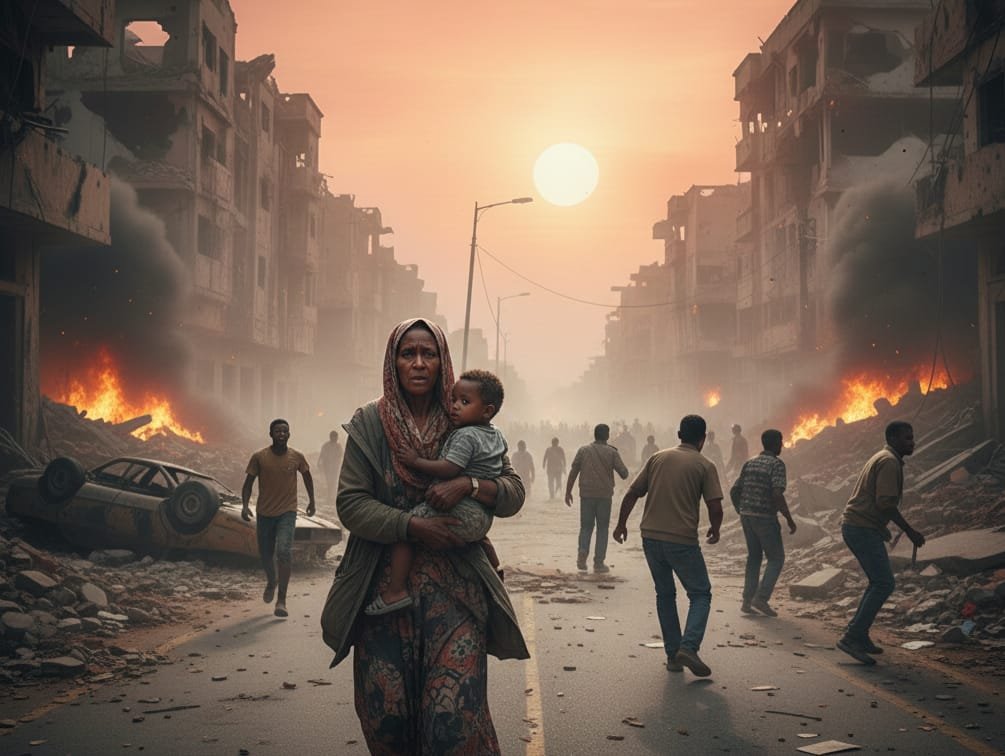
The conflict has since evolved into what is now widely described as the world’s largest and fastest-growing displacement and humanitarian crisis.
Massive Displacement:
Approximately, 12 million people have been forcibly displaced, either internally within Sudan or as refugees fleeing to neighboring countries like Chad, Egypt, and South Sudan. One in three Sudanese people have been uprooted from their homes.
Humanitarian Collapse:
Over 30 million people – nearly two-thirds of the population – are in desperate need of humanitarian assistance. Hospitals have been destroyed or rendered non-operational, leading to a collapse of the healthcare system and widespread disease outbreaks like cholera and measles.
Famine and Hunger:
The war has shattered the agricultural sector, leading to crop destruction, disrupted supply routes, and soaring food prices. An estimated 25 million people face acute food insecurity, with areas, particularly in Darfur, confirmed to be experiencing famine conditions.
War Atrocities:
Both the SAF and the RSF have been accused of committing war crimes and atrocities against civilians, including indiscriminate attacks, sexual violence, forced displacement, and ethnically motivated mass killings, particularly in the Darfur region (like the fall of El Fasher).
And, Uncertain Future:
As the civil war grinds on into its third year, the situation remains dire. Diplomacy has largely failed to achieve a lasting ceasefire, and external powers have been accused of fueling the conflict by supplying weapons to their respective allies. The violence continues to spread, leading to a de facto partition of the country, with the RSF largely controlling Darfur and the SAF consolidating power in the east, centered around Port Sudan.
The crisis in Sudan is a story of a nation unable to break free from cycles of violence and autocratic rule. With a generation’s future at risk and the humanitarian toll mounting daily, the international community faces the immense challenge of pressuring the warring factions to end the fighting and securing unimpeded access for life-saving aid to avert a complete catastrophic collapse.DD